To illustrate and simulate locking and blocking let me first prepare a dummy table and two database accounts for simulation:
create table SH1.purchase_orders ( product varchar2(20), sales number (5));
SQL> insert into SH1.purchase_orders values (‘milk’, 20);
SQL> insert into SH1.purchase_orders values (‘corn_flakes’, 40);
SQL> insert into SH1.purchase_orders values (‘cheese’, 16);
SQL> create user jerry identified by jerry;
SQL> grant create session to jerry;
SQL> grant select,update on SH1.purchase_orders to jerry;
SQL> create user donald identified by donald;
SQL> grant create session to donald;
SQL> grant select,update on SH1.purchase_orders to donald;
// as shown below both max_idle_time, max_idle_blocker_time are set to “0” which means unlimited
SQL> show parameter idle
NAME TYPE VALUE
———————————— ———– ——————————
max_idle_blocker_time integer 0
max_idle_time integer 0
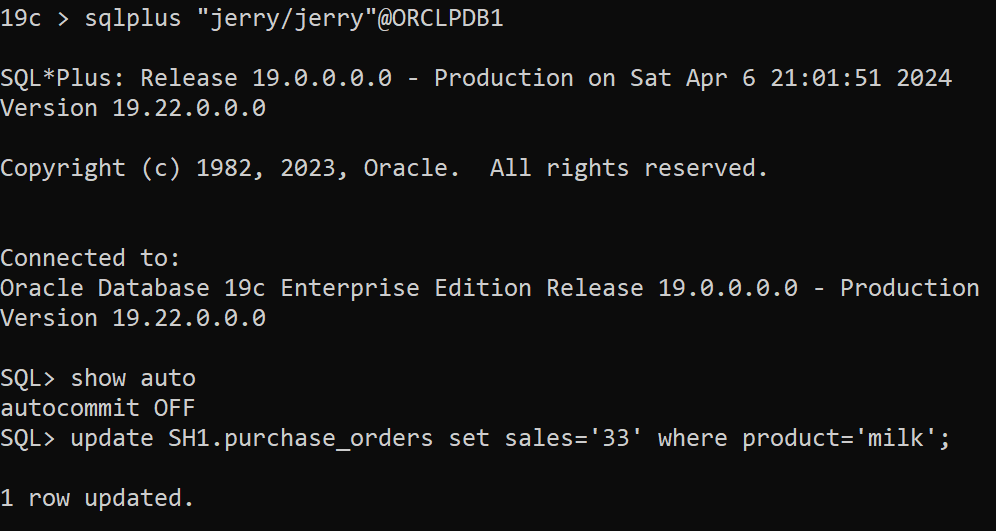
In the first session as user jerry and auto-commit is to “FALSE” as shown below so you will need to explicitly end the transaction either by “commit” or “rollback”:
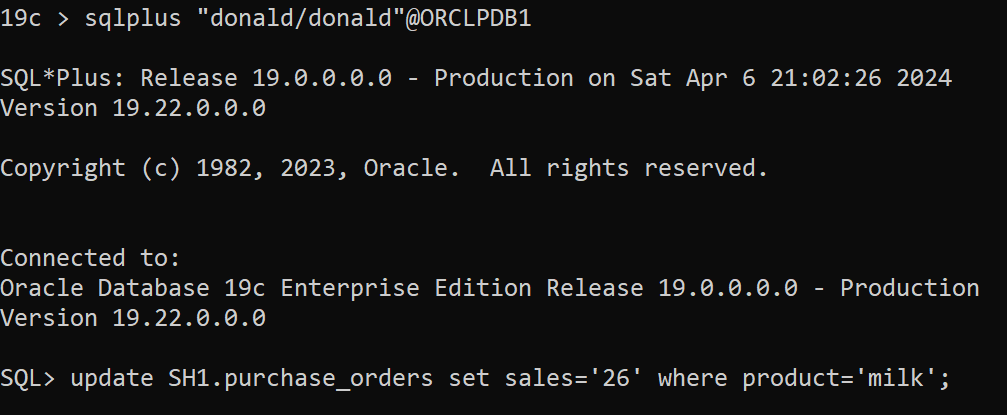
In the second session as user donald [ donald session is hanging because there is already shared row lock on the table]
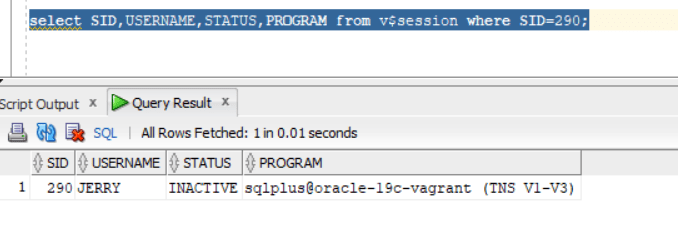
To find blocking session:
SQL> select * from v$lock where block >0;

SQL> select SID,USERNAME,STATUS,PROGRAM from v$session where SID=290;
To find locking:
SQL> select * from V$SESSION_EVENT where WAIT_CLASS=’Application’ and EVENT like ‘enq: TX – row lock contention’;

SID 283 is for account “donald”
So, based on the above scenario lock/block will remain unless jerry’s session commit or rollback.
Let us now explore max_idle_blocker_time parameter and set to 1 minute at the pluggable database level:
sqlplus / as sysdba
SQL> alter session set container=ORCLPDB1;
Session altered.
SQL> alter system set max_idle_blocker_time=1;
System altered.
SQL> show parameter idle
NAME TYPE VALUE
———————————— ———– ——————————
max_idle_blocker_time integer 1
max_idle_time integer 0
Repeat the scenario again….
After 1 minute in jerry’s session:
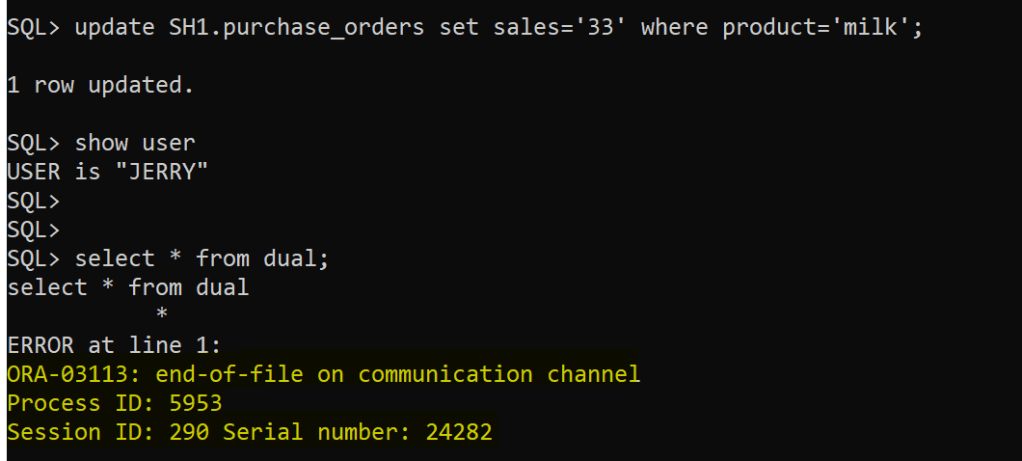
The session is terminated as expected after 1 minute
And, blocking disappears however locking from “donald” session will remain so it will require either “commit” or “rollback” for the transaction being executed.
 Geodata Master